|
|
|
Two major reports released: BIO's new analysis of the bioscience industry and CDC's AMR report. (869 words, 3 minutes, 29 seconds) |
|
|
|
New BIO-CSBA-TEConomy report finds $3.19T bioscience industry |
|
|
Bioscience generates $3.19 trillion in total U.S. economic output and employs 2.31 million people across over 156,000 business establishments, according to the latest 2026 report from BIO in partnership with the Council of State Bioscience Assocations (CSBA) and TEConomy Partners.
A leading resource, produced for BIO every two years since 2004, the report surveys the bioscience industry on the national, state and local levels. It features individual reports for 50 states, Puerto Rico and the District of Columbia.
The industry grew 7% from 2021 through 2025, though the pace slowed toward the end of that period, the report says. Forty-one states, DC, and Puerto Rico experienced bioscience employment growth. Job-gain leaders include Texas, Florida, Massachusetts, Illinois, and North Carolina.
Bioscience jobs are good jobs, paying $145,188 annually on average, 84% above the private sector average.
A vast clinical trial ecosystem: A special section catalogues 63,468 distinct clinical studies during 2021–25, in every state, DC, and Puerto Rico. The top five: California (16,738), Texas (13,742), New York (12,695), Florida (11,686), and Pennsylvania (9,395).
Biomanufacturing boom: A subsector profile finds biological product manufacturing employed 46,936 workers in 2025, up 15.8% from 2021.
The big picture: “America’s bioscience industry continues to create jobs, fuel economic growth, and deliver life-saving medicines to patients. The United States must continue promoting an environment that supports scientific discovery and strengthens our leadership in biotechnology. This report makes clear that we cannot take that strength for granted. Now is the time to invest in America's biotech ecosystem, advance policies that foster innovation and lay the groundwork for America’s long-term leadership for years to come,” said BIO President & CEO John F. Crowley.
Read more on Bio.News.
Read the report here. |
|
|
|
New CDC report catalogues AMR’s threats |
|
|
The CDC’s latest report on antimicrobial resistance (AMR) identifies 19 dangerous pathogens causing an estimated 9.7 million infections and 50,800 deaths in the U.S. annually.
The first comprehensive update of the Centers for Disease Control and Prevention (CDC) Antimicrobial Resistance Threats Report since 2019 was released Oct. 27. Its data is intended “to help guide policy, investments, and interventions to combat” the growing threat of AMR.
Details on pathogens include associated deaths and healthcare costs. For example: Seven bacteria “commonly associated with health care caused more than 42,000 deaths in 2023 and resulted in nearly $12 billion dollars in healthcare costs.”
We need new antimicrobials to combat these pathogens, which have evolved and developed resistance to existing antimicrobial treatments. But developers of new treatments are struggling because the market for new, innovative antimicrobials is fundamentally broken.
A policy solution: The bipartisan PASTEUR Act proposed in Congress would provide predictable support for qualifying new antimicrobials that treat the most critical infections, ensuring health care providers have the tools needed to treat superbugs.
BIO’s view: “This latest report shows more detail on the enormous threat of AMR, which we know has the potential to cause nearly 170 million deaths worldwide by 2050,” says Emily Wheeler, BIO VP of Infectious Disease Policy. “We need new antimicrobials for the most critical infections, and the only way to get that is with policy solutions that encourage development and innovation, such as the PASTEUR Act.”
Read more on Bio.News.
Read CDC’s Report.
Read BIO’s timeline of the broken AMR market. |
|
|
|
|
|
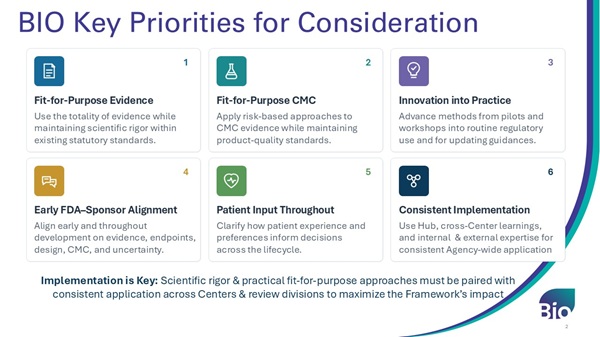
BIO voiced support for FDA’s Fit-for-Purpose Rare Disease Framework Initiative and offered recommendations for effective implementation. At FDA’s Oct. 28 public meeting, BIO emphasized fit-for-purpose evidence generation, early and ongoing sponsor alignment, meaningful patient input, risk-based CMC approaches, and the importance of translating innovative approaches into regulatory practice. BIO also highlighted the need for consistent application across FDA Centers and review divisions, as well as leveraging both internal and external expertise where appropriate (see slide above). At the meeting, E’Lissa Flores, BIO Senior Director, Science and Regulatory Affairs, underscored the Framework’s potential to bring greater predictability to rare disease development while maintaining scientific rigor and FDA standards. Read more on Bio.News.
BIO PACE panels break down patient access. Challenges to access were a primary focus of BIO’s 15th annual Patient Advocacy Changemakers Event held Oct. 22-23 in Washington, DC, and several expert panels explored barriers to coverage. CancerCare social workers receive a thousand calls a week from patients surprised by step therapy requirements, said Kim Czubaruk, CancerCare Policy VP. “But behind each call is a patient or a caregiver that really is probably in the toughest moment of their life.” Experts discussed utilization management, coverage appeals, clinical guidelines, and using statistics. Read more on Bio.News.
Regeneron extends agreement with BARDA to supply Ebola treatment. BIO member Regeneron announced an extension of its longstanding partnership with the Biomedical Advanced Research and Development Authority (BARDA) to supply additional doses of Inmazeb®, the first Food and Drug Administration (FDA)-approved Ebola treatment, through 2031. Amid an ongoing Ebola Bundibugyo virus (BDBV) outbreak, this agreement underscores the importance of public-private partnerships to ensure America can respond to future Ebola outbreaks and other emerging biological threats. Read more here. |
|
|
|
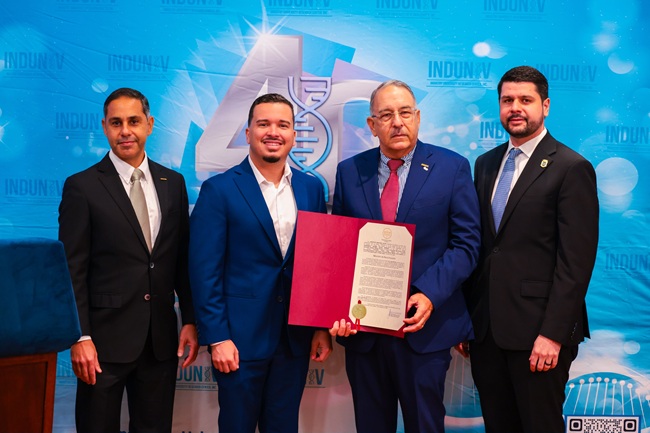
As part of Puerto Rico’s 23rd Annual INDUNIV BioSciences Celebration organized by BIO affiliate INDUNIV, BIO held a Genomic Medicine Briefing on Oct. 16, in Puerto Rico’s Legislative Building. Pictured, from left, during presentation of a proclamation from Gov. Jenniffer Gonzalez-Colon: Henry Terc (INDUNIV Board Chair), Sen. Wilmer Reyes (Chair of the PR Senate Science, Technology & AI Committee), Ivan Lugo-Montes (President and CEO of INDUNIV), and PR Economic Development and Commerce Secretary Carlos Rios Pierluisi. |
|
|
|
|
Both the House and Senate are back home campaigning through the election. They will return the week of Nov. 9.
|
|
|
|
|
|